
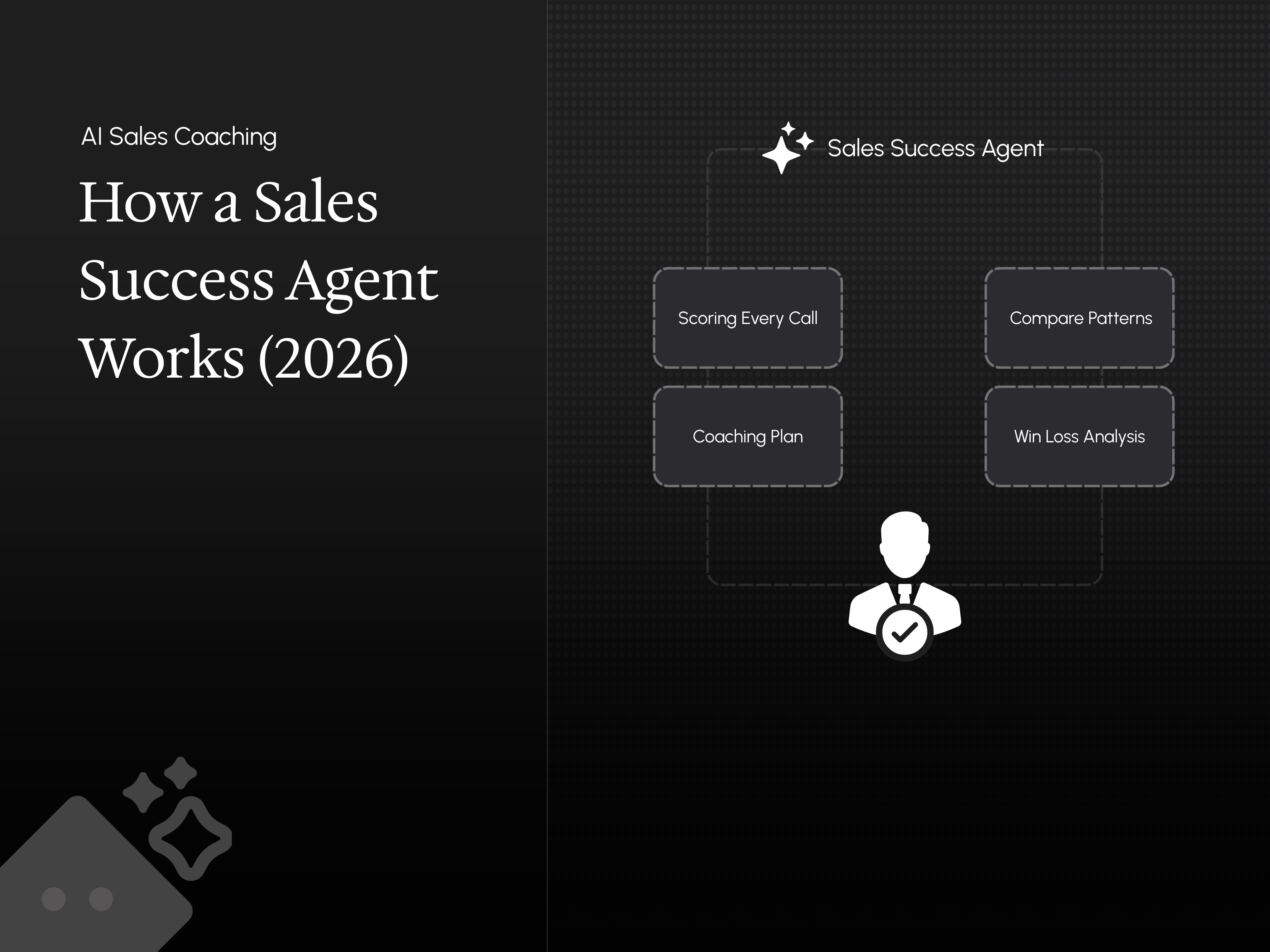
A Sales Success Agent is an AI system that scores every sales call against a defined rubric, compares each rep’s performance against top-performer patterns on the same team, and generates a personalised coaching plan after every conversation. It runs win and loss analysis continuously across the pipeline and delivers coaching insights to reps before managers see them, so the one-on-one becomes a forward-looking conversation rather than a performance review.
The Coaching Capacity Problem Every Sales Manager Has
Every sales manager knows exactly which reps are performing and which are not. The harder question is why.
A rep who is missing quota at month four of their tenure is not missing it because they lack effort. They are attending the right calls, sending the right volume of follow-ups, and working the pipeline with the same motion as the reps around them. But their close rate at stage three is twelve points below the team average. Their discovery calls are running long and ending without a confirmed next step at a higher rate than anyone else on the team. And the MEDDPICC scorecard in their deals consistently shows the economic buyer field incomplete even on deals that have been “open for six weeks”.
The manager knows all of this in a general sense. What they do not have is the time to review every call this rep has made in the last month, cross-reference it against the deals that closed and the ones that did not, generate a specific coaching plan based on the actual patterns in the data, and deliver that coaching in a form the rep can act on before the next call.
The manager has a team of twelve. This rep is one of them. The detailed analysis that would produce a precise, personalised coaching plan for this individual would take the better part of a day to complete. The manager does not have a day. They have a one-on-one on Thursday that will last thirty minutes and cover six topics.
This is the coaching capacity problem. And it is the problem the Sales Success Agent inside the Quantum Heaps Unified Revenue Engine was built to solve.
What Is a Sales Success Agent?
A Sales Success Agent is a specialised AI agent that owns rep development and performance inside a B2B sales organisation. It reads every call, scores it against a defined rubric, compares rep performance against top-quartile patterns in the same situations, generates a personalised coaching plan for each rep, and runs win and loss analysis continuously across the entire pipeline.
Its primary measures of success are coaching actions completed, methodology adherence over time, and ramp time for new reps. These three metrics are leading indicators of the output metrics that matter most to sales leaders: win rate, quota attainment, and forecast accuracy. An organisation that improves all three will see those output metrics follow.
The Sales Success Agent does not replace the sales manager. It makes the manager’s time dramatically more valuable by doing the observation, analysis, and diagnosis work that currently consumes the hours the manager does not have, and delivering the output of that work in a form the manager can act on directly.
Why AI Sales Coaching Frequency Determines Revenue Outcomes
The relationship between coaching frequency and quota attainment is one of the most consistent findings in B2B sales research.
According to the Sales Management Association, sales reps who receive weekly coaching attain 76 percent of their quota on average. Reps coached only quarterly attain 47 percent. That 29-point gap does not come from talent differences. It does not come from territory advantages. It comes from how often a rep receives meaningful, specific feedback on their actual conversations.
Ramp time compounds the problem. According to Saleshood’s 2026 Sales Productivity Report, the average B2B sales ramp time has extended to 5.7 months, up from 4.3 months in 2020. The deals are more complex. The buying committees are larger. The qualification frameworks are more demanding. The revenue lost during that extended ramp period does not appear as a line item in the budget. It appears in the forecast miss at the end of the quarter.
The obstacle to solving this has never been understanding. Every sales leader knows that more frequent, more specific coaching produces better reps. The obstacle has been capacity. There are not enough hours in a manager week to coach twelve reps at the frequency the data says makes a difference.
How a Sales Success Agent Works
Scoring Every Call Against a Defined Rubric
The first thing the agent does after every call is score it against the team rubric inside the Quantum Heaps AI-native CRM. Not a generic rubric built from abstract best practice. A rubric built from the specific behaviours that predict success in this team, in this market, at this stage.
The rubric evaluates whether the rep established the prospect’s current state before proposing a solution. Whether they confirmed the economic buyer or assumed one existed. Whether they closed the call with a specific next step and a date, or left it open with a vague commitment to follow up. Whether they allowed the conversation to stay in product feature discussion when the discovery was incomplete. Whether they handled the pricing objection by defending the price or by anchoring to the value that justified it.
Every one of these is a scorable behaviour. Every call produces a score. Not a number out of ten. A structured assessment of specific behaviours, each one annotated with the moment in the transcript where the evidence appears.
This is the foundation that makes everything else possible. Not a subjective impression of how a call went. An objective, consistent, evidence-based evaluation of what actually happened, produced for every call, for every rep, every day.
Comparing Against Top Performer Patterns
The raw score is useful. The comparison is where the AI sales coaching intelligence lives.
The agent does not just tell a rep they scored 6.2 on their last discovery call. It tells them that the top performers on the team, in the same call type, at the same deal stage, with the same prospect profile, consistently do three specific things differently. They confirm the decision process before the prospect volunteers it. They name the compelling event explicitly rather than waiting for it to surface. They close with a question rather than a statement.
This comparison is built from the actual call data of the top performers on the same team, not from a library of generic best-practice examples. The patterns are specific to the product, the market, the buyer profile, and the competitive environment that this team operates in. And they are always current because the agent is reading new calls continuously and updating the pattern library as the data accumulates.
According to Quantum Heaps customer deployment data (measured across onboarded B2B sales teams between January and August 2026, tracking time from hire to first closed deal at or above 80 percent of ramped quota), reps receiving AI sales coaching informed by top-performer comparisons reach full productivity 30 to 50 percent faster than those receiving only traditional manager-led coaching. The feedback is more specific, more timely, and more consistently delivered than what a manager with a full team and a full calendar can produce.
Generating a Per-Rep Coaching Plan
The output of the scoring and comparison is a personalised coaching plan for each rep.
Not a list of generic improvement areas. A specific, prioritised set of actions tied to the actual behaviours the agent identified as gaps in this rep’s recent calls, ranked by the expected impact on their close rate and deal velocity if improved.
For example: a new rep four months into their tenure whose calls show consistent incomplete economic buyer confirmation might receive a plan prioritising three things: a review of the two best economic buyer discovery calls from senior reps in the library, a practice session focused on navigating to the budget conversation without creating friction, and a specific question to add to the pre-call checklist before every discovery call this week. These are illustrative examples of the coaching plan structure, not reported customer outcomes.
For a senior rep whose numbers have slipped in the last six weeks, the plan might identify a specific pattern shift: the discovery section of their calls has shortened by an average of eight minutes over the period, and the calls where that shortening occurred have a 40 percent lower advance rate than the ones that maintained the standard duration. These figures are illustrative of the pattern analysis the agent performs, not a universally observed result. The implication is not that the rep needs to talk more. It is that something in the conversation flow changed, and the agent has identified where and when.
Who Sees What and When
The agent surfaces insights to the rep before the manager sees them. This sequencing is intentional.
A rep who sees their own call analysis before a manager raises it in a one-on-one is in a fundamentally different position than one who hears the feedback for the first time from above. The first conversation is collaborative. The second is evaluative. Collaborative conversations produce better outcomes.
A rep who has already seen their performance data and their coaching plan before the one-on-one has had the chance to reflect on it and arrive at the conversation with their own assessment of what happened and what they want to work on. The manager walks in with a prepared rep, not an uninformed one. The thirty minutes available becomes coaching time rather than briefing time.
The manager receives a weekly digest summarising the coaching actions completed, the methodology adherence trends across the team, the reps whose patterns have shifted materially in either direction, and the win and loss themes emerging from the data. This digest surfaces exactly what they need to know without requiring the manager to have reviewed every call themselves.
Running Win and Loss Analysis Continuously
Every closed deal, won or lost, is an opportunity to understand what determines outcomes in this market, with this product, against this competitive environment.
In most sales organisations, this analysis happens infrequently, incompletely, or not at all. A quarterly business review might include a slide on top loss reasons, built from the dropdown field reps selected when they marked a deal as closed lost. The problem is that the dropdown field rarely captures the actual reason. A rep who lost a deal might select pricing as the loss reason because it was the last objection raised, even if the real reason was that the economic buyer was never properly engaged.
The Sales Success Agent reads the full conversation history of every closed deal and generates a loss reason analysis based on what was actually said, not what was selected from a list. It identifies the qualification gaps that were present in the deal record for lost deals and absent in the record for won deals. It surfaces the stage where deals most frequently stall before dying. This analysis runs continuously, is available at any point, and is filtered by rep, territory, deal size, or any other dimension that helps the team understand where to focus. You can read more about how this connects to the broader revenue operations function.
What Changes for New Reps
The impact of AI sales coaching is most visible in the first six months of a new rep’s tenure.
Traditional onboarding transfers knowledge through documentation, training sessions, and informal shadowing of senior reps. The problem is that the knowledge that matters most is not in the documentation. It is in the hundreds of calls the senior rep has made, the specific language they use at each stage, the way they navigate the moment when a prospect raises an objection, the question they ask when the conversation stalls.
This knowledge is invisible to a new rep unless they are present on enough of the right calls at the right moments to absorb it. In a distributed team, this absorption happens slowly and inconsistently.
The Sales Success Agent makes this knowledge structural. The top performer call library is searchable and analysed. The coaching plan for a new rep includes specific examples from real calls by real senior reps on the same team, tied to the situations the new rep is most likely to encounter in the deals they are currently working.
According to Quantum Heaps customer deployment data (same cohort referenced above, January to August 2026), new hires with access to AI sales coaching informed by team-specific top performer patterns reach full productivity 30 to 50 percent faster than those receiving only traditional onboarding. The institutional knowledge that previously required 5.7 months to absorb through proximity and luck is now structured, searchable, and delivered in context from day one.
Sales Success Agent vs Traditional Sales Coaching
| Dimension | Traditional Coaching | Sales Success Agent |
| Coverage | Selected calls, selected reps | Every call, every rep, every day |
| Feedback timing | Days to weeks after the call | Available the same day |
| Feedback specificity | Manager impression | Evidence-cited, timestamp-linked |
| Ramp time impact | 5.7 months average (Saleshood 2026) | 30 to 50% reduction (QH customer data) |
| Win and loss analysis | Quarterly, dropdown-based | Continuous, conversation-based |
| Manager time required | 4 to 8 hours per rep per month | Weekly digest review only |
| Coaching consistency | Varies by manager | Consistent rubric applied to all |
The Guardrails That Keep Coaching Safe and Trusted
The Sales Success Agent operates within three principles that shape how AI sales coaching is delivered.
No punitive scoring. The call evaluations are coaching tools, not performance weapons. A rep who scores below the rubric benchmark receives a coaching plan for that behaviour, not a warning.
Transparent tracking scope. Every rep knows exactly what the agent reads, what it scores, and how it shares that data. Teams that know how they are being evaluated perform better on the dimensions being evaluated than teams who suspect they are being monitored but do not know how.
Coaching first. Every output of the agent is framed around what to do differently rather than what was done wrong. A coaching conversation that starts from what to improve produces different outcomes than one that starts from what failed. This is also how the sales enablement layer connects – battle cards and content surface in the same coaching moment where the gap was identified.
How Agent Q Delivers the Sales Success Agent Inside Quantum Heaps
Agent Q does not operate as an isolated coaching tool sitting outside the revenue workflow. It runs as the intelligence layer of the same platform where the deal lives, the call was recorded, the MEDDPICC was scored, and the follow-up was sent inside the Quantum Heaps Unified Revenue Engine.
When the Digital Sales Agent joins a call and produces the MEDDPICC scorecard, that scorecard does not sit in a separate system waiting for someone to review it. Agent Q reads it immediately as coaching input. It compares the scorecard against the rubric, identifies the specific gaps, cross-references those gaps against the patterns of top performers on the same team, and begins building the rep coaching plan before the rep has finished reading the follow-up email draft.
By the time the rep opens their Quantum Heaps dashboard after the call, three things are waiting for them. The call summary from the Digital Sales Agent. The MEDDPICC scorecard with evidence citations. And a coaching card from Agent Q that says: in this call, two criteria were flagged as unconfirmed. Here is how the top performers on your team handle the same situation. Here is the specific question that consistently opens the economic buyer conversation. Here is a recording timestamp from a senior rep call where this was handled in the way the data says works.
This coaching card is specific to this call, this deal, and this rep. It required no manager time to produce.
The manager receives a digest before the one-on-one showing the rep coaching card, the methodology adherence trend over the last four weeks, and the two specific behaviours identified as the highest priority for this rep based on their deal outcomes. The manager walks in knowing exactly what to focus on. The rep walks in having already reflected on the same data.
The win and loss analysis Agent Q runs feeds back into the same record. When a deal closes lost, Agent Q reads the full conversation history, compares it against the qualification record, and updates the loss theme library. If a new objection pattern is appearing consistently in calls where deals are being lost, the Sales Success Agent surfaces it in the coaching plan for every rep likely to face the same situation, and routes it to the enablement team to update the relevant battle card. Every deal that closes teaches the system something about what works in this specific market. The longer Agent Q runs, the more precisely it understands what great looks like for this team.
This is what AI sales coaching means in the context of Quantum Heaps. Not a coaching feature added to an existing AI-native CRM. An always-on intelligence layer that identifies the gaps between where each rep is and where the data says they could be, and delivers the specific, timely, evidence-based coaching that closes that gap.
Frequently Asked Questions About AI Sales Coaching
What is a Sales Success Agent?
A Sales Success Agent is an AI sales coaching system that scores every call against a defined rubric, compares rep performance against top-quartile patterns on the same team, generates a personalised coaching plan, and runs win and loss analysis continuously. Inside Quantum Heaps, it is delivered by Agent Q.
How is AI sales coaching different from a traditional coaching tool?
A traditional coaching tool stores recordings and makes them searchable. An AI sales coaching agent scores every recording automatically, compares it against top-performer patterns, and delivers a specific plan to the rep the same day- without any manager input required.
Does the Sales Success Agent replace the sales manager?
No. It removes the observation, analysis, and diagnosis work that consumes manager time and delivers a structured output the manager acts on directly. The coaching conversation still happens between manager and rep, but with better information on both sides.
Why does the rep see their insights before the manager?
Because collaborative conversations produce better outcomes than evaluative ones. A rep who has already reviewed their coaching plan before the one-on-one arrives prepared and reflective. The sequencing is deliberate.
How does the Sales Success Agent reduce ramp time for new reps?
It makes top-performer knowledge structural rather than incidental. New reps receive examples from real senior rep calls tied to their current situations. According to Quantum Heaps deployment data (January to August 2026, B2B sales teams), this reduces time to full productivity by 30 to 50 percent versus traditional onboarding.
What are the guardrails on how AI coaching data is used?
Three principles apply: no punitive scoring, transparent tracking scope, and coaching-first framing. Reps know what is evaluated and how. Output is always improvement-oriented, never punitive.
How does the agent run win and loss analysis?
It reads the full conversation history of every closed deal and produces a loss reason from what was actually said, not what was selected in a dropdown. It identifies qualification gaps and stall patterns, and updates every time a deal closes.
The Sales Success Agent is the third of five specialized agents inside the Quantum Heaps Unified Revenue Engine. It turns every call into a coaching opportunity, every closed deal into a learning asset, and every new hire into a faster-ramping contributor to the pipeline. See how Agent Q works | Explore the Sales Leader solution | Read about Sales Enablement | View pricing